
Each patient’s experience with bladder cancer is unique.1 This is due in part to the wide variety of ways bladder cancer can appear. The type of bladder cancer can greatly affect how quickly a tumor can grow, how it responds to different treatments, and ultimately how the patient may be affected by the cancer (the patient’s prognosis).
For these reasons, healthcare providers perform a number of tests to determine important characteristics about your cancer, and often use specific (sometimes very technical) language to describe these characteristics. These characteristics include:
- The histological type – this refers to the type of cell in the bladder from which the tumor first grows. More than 90% of bladder cancers in the United States are known as urothelial carcinoma; however, the less common bladder cancers may not respond to treatments in the same way, so it’s very important for your healthcare providers to determine the type of bladder cancer2
- The stage – this refers to how much the cancer has spread to nearby organs, lymph nodes, and beyond; lower stage cancers (which are more localized) are generally treated with better outcomes than higher stage cancers that have spread to distant organs3
- The grade - this refers to how abnormal the cancer cells look compared to their healthy counterparts; the more abnormal cells tend to be more aggressive, grow more quickly, and may be more likely to spread4
- Recurrence – this refers to whether the tumor is new or whether it has previously been treated and has come back. Recurrent cancers can potentially become resistant to some therapies4
Technical Terms

About the bladder
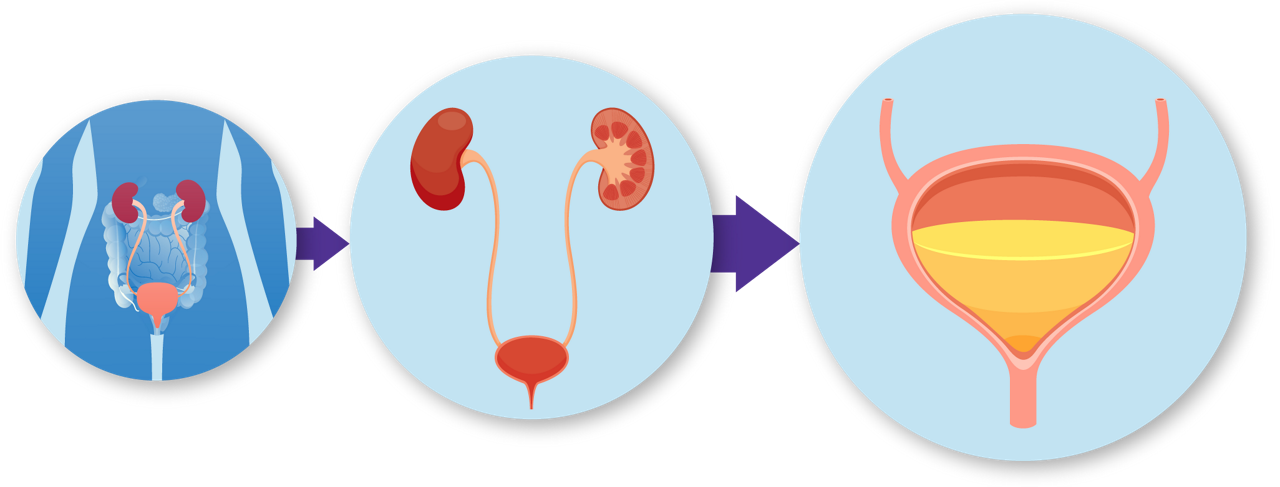
The urinary bladder is a triangular, hollow, stretchable sac and it serves as a reservoir for urine.6-8 The bladder is part of your urinary tract which is a collection of organs that work to filter waste products from blood and expel the waste from the body as a liquid (urine). The bladder is located in the lower abdomen and it contains a muscular wall that expands to hold urine produced by the kidneys and contracts to expel urine from the body. The kidneys, located on either side of the backbone above the waist, act together with the bladder to eliminate toxins and waste from the body through urine. Urine passes through each kidney and enters the bladder via long tubes known as ureters. The bladder holds the urine until it leaves the body through a tube known as the urethra.
Did you know?

Types of bladder cancer
There are different types of bladder cancers, depending on the types of cell from which the tumor grows.13 Healthcare providers might refer to this as the histological type. The type of bladder cancer a patient has can in part affect the patient’s prognosis and their treatment options. Select the types of bladder cancer below to learn more.
Urothelial carcinoma
Squamous cell carcinoma
Adenocarcinoma
Small cell carcinoma
Sarcoma
Urothelial carcinoma grows from the cells lining the inside of the bladder. These urothelial cells expand when the bladder is full and contract when it is empty. The same cells also line the inside of the ureters and the urethra where cancers can also develop. Urothelial carcinoma is the most common type of bladder cancer in the United States and accounts for 90% to 95% of all bladder cancer diagnoses. Urothelial cells are sometimes called 'transitional cells' for their ability to change size and shape. Therefore, sometimes 'urothelial carcinoma' is also called 'transitional cell carcinoma'.13,14
Squamous cell carcinoma grows from squamous cells, which are flat cells that line the inside of the bladder. Squamous cell carcinoma is linked to chronic bladder irritation, such as from an infection or prolonged use of a urinary catheter. This type of bladder cancer accounts for 5% of the urinary tumors diagnosed in the United States.13,14,17
Adenocarcinomas are cancers in the glands that line your organs, including your bladder. This is a rare type of bladder cancer, accounting for only 1% to 2% of all bladder cancers.10,14
Small cell carcinoma begins in nerve-like cells that release hormones into the bloodstream in response to signals from the nervous system. This type of cancer is very rare and affects only about 1,000 people in the U.S.10,15,16
A sarcoma is a type of cancer that starts in the connective tissues of the body, such as muscles, bones, fat, and cartilage. Unlike more common cancers, which often begin in the skin or organs, sarcomas develop in the supportive tissues. Bladder sarcomas develop in the muscle cells; however, this type of cancer is extremely rare.17
What is muscle-invasive bladder cancer?
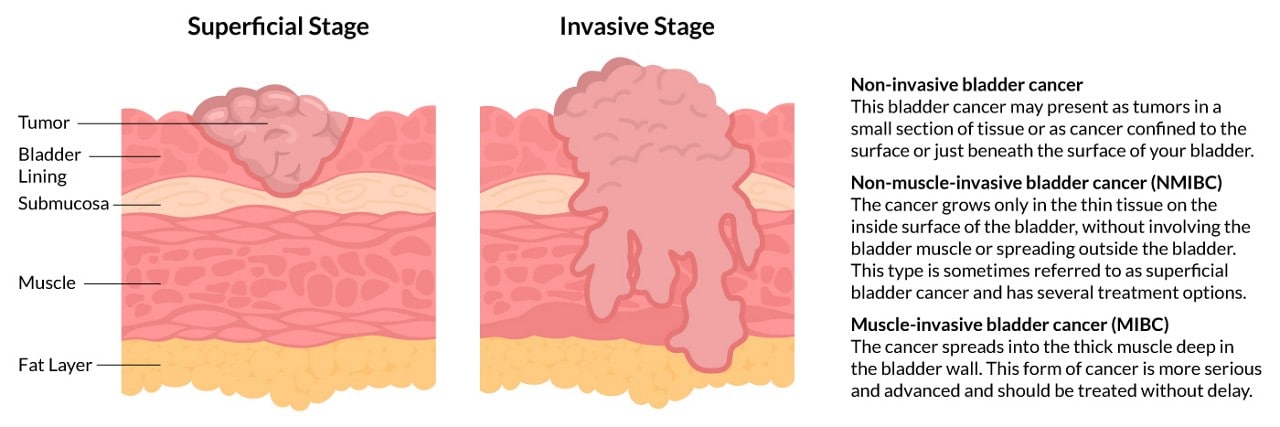
Healthcare providers may also categorize bladder cancer as being noninvasive, non-muscle-invasive, or muscle-invasive.10,18
What are the stages of bladder cancer?
Staging is a thorough process used by healthcare providers to determine and describe if the cancer has invaded the bladder wall, whether it has spread, and, if so, to which parts of the body.3
Bladder cancer is usually staged using the TNM staging system, which considers4:
- How big the cancer is, or tumor size (T)
- Whether the cancer has spread to nearby lymph nodes (N)
- Whether it has spread to distant parts of the body from the bladder, called metastasis (M)
Tumor (T)
Lymph Node (N)
Metastasis (M)
There are several T stages19:
- CIS or Tis indicates very early, high grade cancer cells are found only in the innermost layer of the bladder lining.
- Ta indicates the cancer is just in the innermost layer of the bladder lining.
- T1 indicates the cancer has begun to grow into the connective tissue under the bladder lining.
- T2 indicates the cancer has grown into the muscle through the connective tissue.
- T3 indicates the cancer has grown into the fat layer through the muscle.
- T4 indicates the cancer has spread outside the bladder.
Lymph nodes are small bean-shaped structures that play a crucial role in the body's immune system. They filter substances carried by the lymphatic fluid and contain lymphocytes (white blood cells) that assist in combating infection and disease.20
Cancer cells can enter the lymphatic system and travel around the body. There are 4 lymph node (N) stages in bladder cancer - N0 to N3.21
- N0 indicates there are no cancer cells in any lymph nodes.
- N1 indicates there are cancer cells in one lymph node in the region between your hip bones, called the pelvis.
- N2 indicates there are cancer cells in more than one lymph node in the pelvis.
- N3 indicates there are cancer cells in at least one lymph node just outside the pelvis.
Your cancer will be called locally advanced bladder cancer if it has spread to nearby lymph nodes (stages N1-3).
There are 2 M stages21:
- M0 indicates your cancer has not spread to other parts of the body.
- M1 indicates your cancer has spread to other parts of the body.
Hence, if the cancer is at TNM stage “T1N0M0”, then it means that the cancer has begun to grow into the connective tissue under the bladder lining (T1) but has not spread to the lymph nodes (N0) or to any other part of the body (M0).21
TNM stage is the single most important prognostic factor of bladder cancer. Based on population statistics , patients with low-stage bladder cancer have a better than 50% chance of being alive 5 years after their initial diagnosis. Patients with high-stage bladder cancer, unfortunately, have less than a 25% chance of being alive in 5 years.21
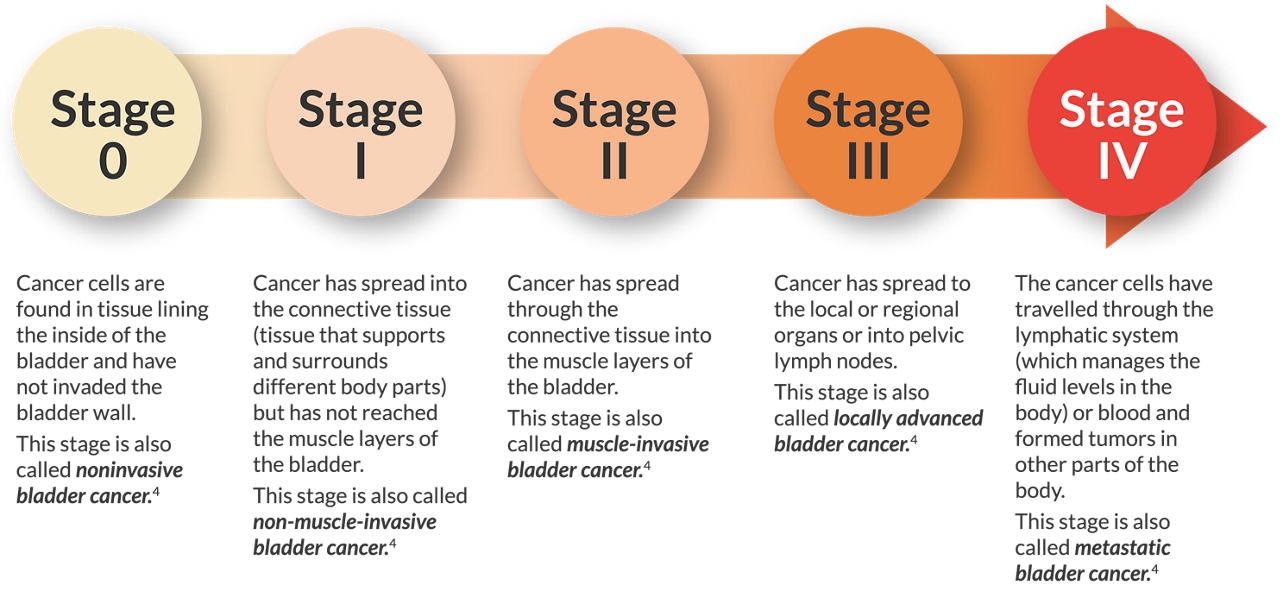
Using the information described in the TNM staging, healthcare providers may also assign an overall stage.4 For bladder cancer, there are five overall stages, designated with Roman numerals 0 to IV. Generally, a lower stage indicates a better prognosis. Early-stage bladder cancer involves only the inner lining of the bladder, whereas more advanced bladder cancer involves the bladder wall and might have spread to nearby organs or lymph nodes.4
What are grades of bladder cancer?
Grade refers to the appearance of the cancer cells and the rate at which they are multiplying.4,13,19
- Low-grade tumors have cells that look quite similar to healthy bladder cells under a microscope and tend to be less aggressive and to grow more slowly.
- A higher grade indicates more irregular cells, which means that they look very different from normal healthy cells. Higher grade is also associated with a greater number of cells multiplying, which means more aggressive, more quickly growing (and quickly spreading) cancer.
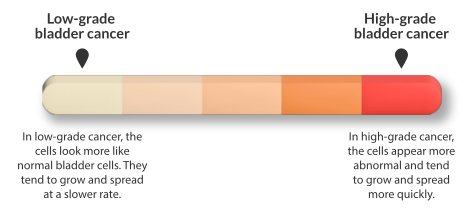
Understanding the grade helps your doctor predict how quickly the cancer will grow and spread.
What is recurrent bladder cancer?
Recurrent bladder cancer is cancer that has recurred (come back) after it has been treated.4 Bladder cancer tends to recur after treatment, even when it is initially noninvasive. Low-grade bladder cancer mainly recurs in the bladder lining. High-grade bladder cancer is more likely to have spread to the muscle layers or other parts of the body when it recurs. Tests are done to help determine where the cancer has returned in your body, if it has spread, and how far. The type of treatment that you have for recurrent bladder cancer will depend on where it has come back.4
Learn more about bladder cancer

Bladder cancer

Key statistics of bladder cancer

Risks and prevention of bladder cancer

Signs and symptoms of bladder cancer

Diagnosis of bladder cancer
- Understanding the Emotional Impact of Bladder Cancer. BladderCancer.net. Updated September 2017. Accessed November 11, 2024. https://bladdercancer.net/coping/emotional-support
- Stephen W. Leslie, et al. Bladder Cancer. NCBI Bookshelf. Updated August 15, 2024. Accessed November 11, 2024. https://www.ncbi.nlm.nih.gov/books/NBK536923/
- Bladder Cancer Guide for Patients. ESMO. Updated July 17, 2024. Accessed November 11, 2024. https://www.esmo.org/content/download/6589/114929/1/EN-Bladder-Cancer-Guide-for-Patients.pdf
- Bladder Cancer Stages. National Cancer Institute. Updated February 16, 2023. Accessed November 11, 2024. https://www.cancer.gov/types/bladder/stages
- Bladder Cancer Stages. Metastatic Cancer: When Cancer Spreads. Updated November 10, 2020. Accessed November 22, 2024. https://www.cancer.gov/types/metastatic-cancer
- Srinivasa Rao Bolla, et al. Histology, bladder. StatPearls - NCBI Bookshelf. Updated February 25, 2023. Accessed November 11, 2024. https://www.ncbi.nlm.nih.gov/books/NBK540963
- Sam P, et al. Anatomy, abdomen, and pelvis: bladder detrusor muscle. StatPearls - NCBI Bookshelf. Updated August 8, 2023. Accessed November 11, 2024. https://www.ncbi.nlm.nih.gov/books/NBK482181/
- The Urinary Tract & How It Works. The National Institute of Diabetes and Digestive and Kidney Diseases. Updated June 2020. Accessed November 11, 2024. https://www.niddk.nih.gov/health-information/urologic-diseases/urinary-tract-how-it-works
- Urine and Urination. MedlinePlus. Updated May 10, 2021. Accessed November 11, 2024. https://medlineplus.gov/urineandurination.html
- Bladder Cancer: OVERVIEW. Cleveland Clinic. Updated August 26, 2022. Accessed November 11, 2024. https://my.clevelandclinic.org/health/diseases/14326-bladder-cancer
- Stephen W. Leslieet al. Bladder Cancer. NCBI Bookshelf. Updated August 15, 2024. Accessed November 11, 2024. https://www.ncbi.nlm.nih.gov/books/NBK536923/
- Anatomy of the Bladder. National Cancer Institute. SEER Training. Accessed November 11, 2024. https://www.training.seer.cancer.gov/bladder/anatomy/
- Bladder cancer. Mayo Clinic. Updated March 29, 2024. Accessed November 11, 2024.https://www.mayoclinic.org/diseases-conditions/bladder-cancer/symptoms-causes/syc-20356104
- What Is Bladder Cancer? National Cancer Institute. Updated February 16, 2023. Accessed November 11, 2024.https://www.cancer.org/cancer/types/bladder-cancer/about/what-is-bladder-cancer.html
- Bethesda. Bladder cancer treatment. PDQ Cancer Information Summaries - NCBI Bookshelf. National Cancer Institute (US). Published September 12, 2024. Accessed November 11, 2024. https://www.ncbi.nlm.nih.gov/books/NBK66044/#:~:text=Bladder%20Cancer%20Causes%20and%20Risk,do%20not%20directly%20cause%20cancer.
- Ismaili N. A rare bladder cancer - small cell carcinoma: review and update. Orphanet J. Rare Dis. 2011;6(1):75. doi:10.1186/1750-1172-6-75
- What Is Bladder Cancer? American Cancer Society. Updated March 12, 2024. Accessed November 11, 2024. https://www.cancer.org/cancer/types/bladder-cancer/about/what-is-bladder-cancer.html
- Bladder Cancer Patient Guide. Urology Care Foundation. Accessed November 11, 2024. https://www.urologyhealth.org/resources/bladder-cancer-patient-guide
- Bladder Cancer Types, Stages and Grades. Bladder Cancer Advocacy Network. Accessed November 11, 2024. https://bcan.org/facing-bladder-cancer/bladder-cancer-types-stages-grades/
- NCI Dictionary of Cancer Terms. National Cancer Institute. Accessed November 11, 2024. https://www.cancer.gov/publications/dictionaries/cancer-terms/def/lymph-node
- Diagnosis of Bladder Cancer. NHS inform. Updated October 14, 2024. Accessed November 11, 2024 https://www.nhsinform.scot/illnesses-and-conditions/cancer/cancer-types-in-adults/bladder-cancer/#diagnosing-bladder-cancer